Showing posts with label Fascism. Show all posts

Wednesday, 20 May 2026

Riparare i Torti - Pino Cacucci


I hadn't read a book by Cacucci in ages. And it's lovely to see that he's still mildly obsessed with Mexico, and that he remains an excellent storyteller. 

As usual, he tells a (fictional) story of forgotten characters based on real events: the Italian sailors left stranded and uncertain in Mexico as a result of their country's entry into WWII. The story is compelling, and while most of the characters and rather dogmatically sketched (there is often little room for nuances) I found it quite easy to grow fond of a lot of them. 

Through the life of the "proper Fascist" whose identity gets stolen Cacucci shows some very justifiable sympathy for those poor idiots who were taken (or allowed themselves to be taken) for a ride by a regime based on hollow promises and misconceptions. Yet, I wish he wouldn't err so much towards the conspirational at times, because he has enough factual history on his hands to make for a really good novel without resorting to too many mysteries and subterfuges. 

Tuesday, 14 October 2025

Bambino - Marco Balzano


After reading Resto Qui I ultimately decided that my perplexities about its plot (and the decision to cover an excessively long time span) were trumped by the fact that I had enjoyed reading something about a (hi)story I knew nothing about. 

So, with the same spirit, I approached Bambino, because the Italian North-East and its recent past remain big mysteries to me. 

I appreciated the fact that the narrator/main character of the novel is deeply unlikeable, and his lack of politics but deep-seated hunger for power, authority, influence, violence and money are ultimately a pretty good reflection of why so many Italians were (are?!?) attracted by the Fascist regime. 

While not a great book, this for me was most definitely a good book. The biggest shame, like with Sunset Boulevard, is that I find it annoying to have a narrator telling his story after his own death is hinted at (or openly depicted) since the very beginning. 

Monday, 15 September 2025

Ferrovie del Messico - Gian Marco Griffi


Meh. 

Acclaimed by the hipsters-who-know as one of the greatest Italian books in recent memory, this picaresque novel made famous by word-of-mouth left me initially untouched, and ultimately bored. 

Initially untouched because the few humorous moments are separated by long pages of forced irony and self-congratulatory prose. 

Yes, you've done your research. Yes, you can write pretty well. But do you need to remind the reader (directly or indirectly) at every page?

And ultimately bored because this book just goes on and on for hundreds of pages (8+, to be precise) and that was so completely unnecessary...

Most likely the novel on Italian Fascism that had the smallest impact on me. Disappointing to say the least...


Tuesday, 28 January 2025

Resto Qui - Marco Balzano


For me, this book was too ambitious. It had plenty of poignant ideas and events to cover: the rise of Fascism and its impact in a German-speaking part of Italy, a pleasant enough love story between people with different approaches to life and levels of education, the decision to submerge a village before WWII to make room for a damn, a hydroelectric power plant, and an artificial lake, and the final completion of the project well after the end of the war and the collapse of the regime. 


Yet, by trying to do all of it in a short novel, the author doesn't really do justice to any of those things: the condemnation of Fascism and its linguistic policies feels little more than a mild tirade, I didn't really care about the individual characters, and I was quite willing to chalk the creation of the artificial lake to "ah, that's progress, it had to happen"...

Sunday, 10 November 2024

I Giorni di Vetro - Nicoletta Verna


Once in a while, it's quite good to realize that there are contemporary Italian writers that, well, know how to write. Like so many in her generation, Verna appears to have a remarkably sombre approach to writing, but even then the story is truly a compelling one. 

The reader understands both the appeal and horror of the titular Vetro, and the deep flaws of his friend (and Redenta's father) get more and more disturbing as the pages turn. Yet, what stands out is the inspiring forms of resistance (be it to a regime, to societal norms, or to family members) that the book celebrates in what feels at times like a touching tribute to Fenoglio. 

And while the surprising spin towards the end of the book (the identity of the mysterious Diaz) is really rather expectable, the surprise in the very final pages (what happened at the ball that marked so much of Redenta and Bruno's lives) is truly surprising. 

Thursday, 14 September 2023

La Malnata - Beatrice Salvioni


And - finally! - a recent Italian book that I actually enjoyed. 

Maybe (actually, surely) not a work of art that is going to land its young author the Nobel prize, but hey at least it's a ray of light in the rather dark landscape of Italian literature. 

La Malnata is the story of two young girls in Fascist Italy. Written in a dry style that at times reminds one of Fenoglio, it features a plethora of secondary characters that are more or less developed (and more or less monolithic), but the two protagonists are neatly thought-out and brought to life. 

It is all a bit predictable, but I can live with that as Salvioni, unlike many of her contemporaries who know how to write (and just don't have any interesting ideas), doesn't seem to be madly in love with herself and allows her prose to roll quite freely. 

Wednesday, 19 July 2023

Thus Bad Begins - Javier Marías


Marías came to do a talk at LSE shortly after Thus Bad Begins some seven years ago. I didn't feel the desperate urge to buy the book and get it signed at the end (instead opting for A Heart So White) and I'm happy to report that my hunch was correct. 

Perfectly flowing prose can only take you so far when the mysteries and secrets surrounding the characters are not particularly interesting (and the final revelations not excessively surprising). The fact that I read this book right after reading another underwhelming one with a much anticipated suicide at the centre (A Little Life) also didn't help. 

Or maybe I just prefer my own kind of Mediterranean fascists, as I often find Italian books discussing the prolonged influence of our regime on our current society much more interesting. 

Monday, 20 February 2023

Caffe' Amaro - Simonetta Agnello Hornby

 Caffè amaro (Universale economica Feltrinelli): Amazon.co.uk: Agnello Hornby,  Simonetta: 9788807890192: Books 

Pathetic. Since Agnello Hornby is considered to be a major Italian author, I figured I had to read something by her at one point or another, but this book was, you guess it, pathetic. 

Set in an overtly romanticized Sicily, at a time when life was better because it was simpler (if you were rich, duh), this love triangle is predictable and vapid. It also reads as the author, and not her characters, is bitter because at the (real or supposed) exploitation of Southern Italy by the North (when her aristocratic family did the exploiting though, things were fine?). 

And, in spite of thanking Christoper Duggan for his historical advice, there are enough historical inaccuracies to rub the reader (or at the very least me!) the wrong way. This is not a 21st century Il Gattopardo. This is a waste of time.

Friday, 10 February 2023

Il Tempo Migliore della Nostra Vita - Antonio Scurati

 Popular fiction Il tempo migliore della nostra vita | Italian |  9788830100046 | The Italian Bookshop 

The typical book that my family keeps aside for me because "it's on Italian Fascism". 

Problem is: half of this book is pretty much my PhD thesis (which I wrote - but not published - way before, by the way). Better written, with much more literary fluorish (though with no historical embellishment) than my work, and ultimately read by a lot more people than the dozen unlucky academics and friends who had to read my dissertation. Still, the overlap was a bit too signifcant for me to find much pleasure in the sections on Leone Ginzburg. 

And the other half was a beautiful portrayal of family life in Fascist Italy. Problem is: there are so many of them around, and I'd always pick the family lives of unknown peasants over the family lives of people who just happened to be lucky enough to have a grandson who would go on to become one of the most acclaimed Italian writers and one who (unlike me!) has actually managed to re-ignite the interest of many Italians in their country's own past. 

So, this is arguably a vanity project, but one that is extremely well-written and worthy of a read, even when half of the book doesn't reserve any surprises (for me, at the very least).

Friday, 3 March 2017

The House of Spirits – Isabel Allende

Am I being overly harsh or is this book simply not of the same standard as Paula? The answer is that maybe I’ve just completely outgrown magical realism (which is sad, because back in the day I had loved A Hundred Years of Solitude so very much).

I honestly think that, had it not been for Clara’s extra sensory abilities, I would have enjoyed the novel a lot more. And I would have probably also liked it better if the characters weren’t ultimately representations of various social and political groups (and periods) in Chilean history (the roman à clef as a genre often gets a bit on my nerves). And the fact that Allende also openly declares that Blanca never married Pedro Tercero because she didn’t love him enough just stings – the guy deserved better.

But then again, most of this probably applies only to 85% of the book, because from the moment Alba gets arrested the novel gains massively in literary, political and moral weight (although it’s really too bad that Allende picked the allegoric name of Alba/Dawn for the character that is meant to symbolize hope for the future – think outside the box!)

Tuesday, 21 February 2017

Una Vita Violenta – Pier Paolo Pasolini


My parents each had a copy of this book when they moved in together back in the 1980s and, thirty years later, realized they had no need for two copies in the same house so gave one of them to me (that said, they’re not even sure whether they read the novel or not!)

I did love Ragazzi di Vita, but I found Una Vita Violenta (which in many ways follows in its footsteps) to be of a whole other calibre. Whereas one grows to like the Riccetto in the former a bit less as the book goes on and he settles within “the system”, I actually fell in love with Tommaso more and more with each page (after feeling the intense desire to strangle him during his football match with kids half his size at the beginning of the book, I just felt the need to protect him from the evils of the world).

Sure, his political path is a bit too allegoric for me, but by the end of the book my nerves were completely shattered. I was glad he did not drown in the flood that hit his old neighbourhood, but the end is really no less devastating (and yet, it is the only way the book could/should have ended in order to be one of the great works of the Italian literature of the last century). 

Thursday, 16 February 2017

1934 – Alberto Moravia

Well, after being left totally indifferent by Gli Indifferenti I had to read another book by one of Italy’s most famous writers. And after all I did love so many of the movies taken from his works (La Ciociara, Il Conformista and Ieri, Oggi, Domani).

1934 is undeniably interesting, but I still didn’t find it that great a read. While a good literary device, the trick that is played on Lucio makes me suffer (I always empathize too much in these cases!) and I also found it rather improbable. Not to mention the fact that the many scenes of a sexual nature to me read mostly like the unfulfilled desires of a 75-year old man.

I also could have done with fewer philosophical passages on the meaning of life and love and more on the nature of Fascism. Also, I find it interesting that Moravia considers the year 1934 to be the 7th of the Fascist stronghold on power, since most historians would make this start either in 1922 with the March on Rome or in 1926 with the “Leggi Fascistissime”, but maybe he referred to the Grand Council of Fascism becoming the Italian constitutional body in 1928. Pedantic, I know, but probably this is as close to a deep academic point I made in the last two years…

Wednesday, 30 November 2016

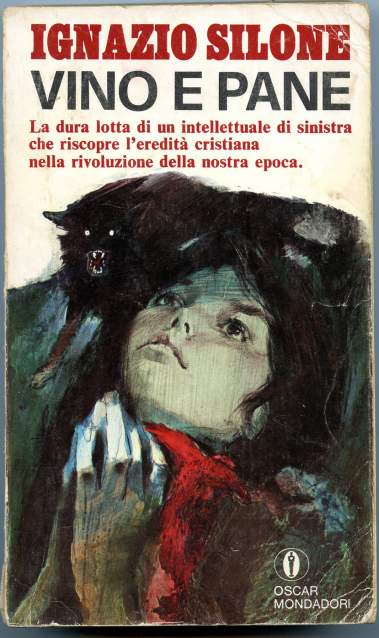
Vino e Pane – Ignazio Silone


One of the books that I got from my grandparents’ shelves (my granddad – despite oddly still remembering most of the first book of the Iliad by heart – is, well, rather “forgetful” these days, and a couple of years ago my grandma has made the rather commendable decision to only read newspapers).

Vino e Pane is a good book about Fascism and its impact on small secluded Italian hamlets. It’s also a book about Catholic piety and communist resistance (I favour one of the two, you can guess which one…) that is probably at its best when the two intertwine, like in the figure of the old Don Benedetto.

While the success that the book has enjoyed, in particular outside of Italy, is perfectly understandable, the quality of this work doesn’t match that of Silone's Fontamara or, for someone who has spent years reading books about Fascist Italy, of most of the works of Fenoglio, Vittorini, Malaparte, Levi, Revelli… So while I’m glad I’ve read it, Vino e Pane doesn’t really crack the top-10 of my favourite novels about the Italian resistance.  

Tuesday, 26 July 2016

Un Giorno di Fuoco – Beppe Fenoglio

And this is a collection of short stories that means a lot to me but, I have to recognize, probably will mean nothing to most non-Italian readers (save maybe a few people from Southern France whose experiences and family histories may have been rather similar).

But, refusing to leave my bias aside, I think that Fenoglio might have been the best Italian writer of the 20th century (surely Il Partigiano Johnny and Una Questione Privata deserve to be considered among the 50 most significant Italian books published over the last 100 years). True, his characters smoke a lot and might have values that are at times anachronistic and at times awfully politically incorrect by today’s standard, but Fenoglio manages to bring to life the common wisdom of the peasantry and their daily problems like no other author, and the short stories of Un Giorno di Fuoco (many of which have nothing to do with Resistance and anti-fascism) are no exceptions. 

Friday, 23 October 2015

Fontamara – Ignazio Silone


Another book stolen from my granddad’s bookshelf. It must have been sitting there for some 40 years. I’m not someone who sees poetry everywhere in the world, but I really find it kind of neat that it smells just like my grandparents’ flat… Clearly, this is another book about Italian Fascism and it is, surprisingly, the one that seems to be best known abroad. Given the recent new evidence published about Silone’s dealings with the Fascist police, I have the feeling I will struggle to be fully objective, but anyway here it goes.

I do realize that Fontamara was published during the “years of consensus” for the Fascist regime  and that Silone’s position was fairly radical and incredibly dangerous at the time (although he published the novel while in exile). However, 80 years on, I am a much bigger fan of Fenoglio’s gritty or Vittorini’s epic anti-fascism than of Silone’s fable-like one.

As I already mentioned a couple of times, I’m not exactly fond of great allegoric portrayals of human nature: I’d be much happier if the evil entrepreneur represented just himself and not the whole of capitalism and its aggressiveness, or if the fickle lawyer was not meant to be a portrayal of the Italian upper-middle class and its acquiescence to Fascism. Also, while the idea of telling the story from the points of view of three members of the same family (a couple and their son) was undoubtedly avant-garde for the period, the fact that the style of the narration doesn’t change when it’s a teenage boy or a middle-aged woman presenting the story makes me question the quality of Silone as a writer.
 
That said, the book is a great display of how in many ways the Fascist revolution was “unrevolutionary”, and how the poor and oppressed remained poor and oppressed. After all that was what my Ph.D. was about, so at least from that point of view I did find the book extremely interesting…

Monday, 28 September 2015

Il Sentiero dei Nidi di Ragno – Italo Calvino


A few years ago I bought for just a couple of Euros the complete works of Calvino. I got excited and thought I was going to read them all, then quickly got bored. Il Sentiero dei Nidi di Ragno, however, is special. Not so much because it’s about the Resistance against Italian Fascism, but mostly because it’s an entirely different Calvino from the one I was used to – not fully realist (despite the fact that the novel has been considered neorealist by some), but not even completely fantastical.

The novel is touching and deep. It offers an allegoric portrayal of the internal divisions of Italian partisans that is both sad and accurate at the same time. The character of Cugino (Cousin) is the kind of rock we all wish we could have in our lives.

Yet, in spite of all this, Il Sentiero dei Nidi di Ragno – probably because is focuses on the story of what is, at the end of the day, just a kid – lacks the elements of violence that to me are so essential to Resistance novels. After all even Calvino himself admitted that the book his entire generation would have dreamt of writing was actually Fenoglio’s Una Questione Privata.

Sunday, 27 September 2015

Il Prete Giusto – Nuto Revelli


Another wonderfully moving book by Nuto Revelli. And yet another one about Italian Fascism (in my defence, I hadn’t written about one of those in a while).

Similarly to Il Mondo dei Vinti, this is oral history at its finest. However, Raimondo Vitale, isn’t like the poor peasants of the other masterpiece by Revelli, he is a man capable of shaping his own destiny (at least to an extent) and to help others. The word “giusto” in the title does not signify that Viale was a just man, but that he was – rightfully – named “Righteous among the nations” because of the help he gave to persecuted Jewish families during the Second World War.

This is a book that students in their final year of high-school should be forced to read (in Italy and France, at least), but again I’m afraid we’re not going to run the risk of that happening anytime soon. So bring on pointless feuillettons from the early 19th century (yes, to this day I am still very fond of Manzoni’s I Promessi Sposi)

Sunday, 20 September 2015

Sostiene Pereira – Antonio Tabucchi


Often people forget that, in the sea of mediocrity that has been the Italian literary landscape for the last 20 years or so, some great books have still been written. And that’s a shame. Often people forget that – though softer than many of its contemporaries – Salazar’s Estado Novo was still a Fascist regime. And that’s probably an even greater shame.

Sostiene Pereira is an excellent book. The reader feels for the uncertainties, aloofness and naivety of old Pereira and at the same time falls in love with the charming and young Monteiro Rossi. The constant repetition of the fact that “Pereira maintains” most of the things happening in the book is a wonderful way to keep the pace of the novel. Lisbon’s melancholy comes alive in Tabucchi’s pages (even more so than in Saramago’s ones in my opinion). And the clarification, in a note at the end of the book, on the racial/religious connotations of Portuguese surnames coming from names for fruit trees (“Pereira” means “pear tree” in Portuguese) puts the novel under a different light.

The movie by Roberto Faenza is also something that should have enjoyed more success than it did, seeing together some of the greatest European actors of the last 30 years (and more): Stefano Dionisi (already mentioned for his role in Il Paritigiano Johnny), the inimitable Marcello Mastroianni, Daniel Auteuil, and Joaquim De Almeida. Ah, and also Nicoletta Braschi, who I think has made a career just out of being Benigni’s wife (why even Jim Jarmusch felt like giving her important roles in some of his movies is just beyond me).

I Ventitré Giorni della Città di Alba – Beppe Fenoglio


Now that I think about it, this was the first book by Fenoglio that I read, at a time in which I hadn’t really started reading yet, and when all the partisans in these short stories had the face of either Stefano Dionisi (who portrayed Johnny in the dramatically underrated movie taken from Il Partigiano Johnny) or of my grandfather (whom I’ve never met, and so was always pictured in my mind as the dashing 20-something year old that I saw in my grandma’s photo albums).

Every place has its proud moments, that get passed down and glorified from generation to generation, and in my region there are very few of those that can compare with the twenty-three days of existence of the Partisan Republic of Alba (one of the first cities in Northern Italy to be – momentarily – freed from Fascist rule).

Fenoglio was a supremely talented writer, able to strip the partisans of their myth and paint them for what they really were: ill-equipped scared little kids with their hearts in the right place. Needless to say, the six stories about the Resistance War in this collection have had much more of an impact on me than those on agricultural life in the period (still extremely interesting, just way less inspiring).