Showing posts with label Communism. Show all posts

Tuesday, 7 February 2023

54 - Wu Ming

 54: Amazon.co.uk: Various authors, Ming, Wu: 9788806220754: Books 

Dad doesn't read as much as mum, and as such doesn't recommend nearly as much. Of the two books I read on his advice, I found one borderline unreadable and the other an incredible work that gave me a little bit of faith in Italian literature. This is the latter of the two. 

Wu Ming is a writing collective that doesn't seek celebrity. It seeks good writing, and man do they achieve it with 54. 

I was skeptical of a story involving Cary Grant (I didn't have a great experience with Stan Laurel in Triste, Solitario y Final and I think that affected me), but his plot was beautifully woven into the other parallel stories. Plus, I got enough hidden references to feel smug. 

And the stories of former partisans, fighters and comrades trying to come to terms with the post-war Italy they had contributed to create were full of pathos and unusual insights. 

Easily one of the best books I've read in 2022, and one that lifted my mood this last Christmas break.

Sunday, 10 June 2018

Monsignor Quixote - Graham Greene


And this is the reason why I was saying that I've probably read too many Graham Greene. Despite the quote from a review from The Spectator on the book's cover, the novel is not Greene's best, or the most absorbing, or adept - it is possibly his most effortless though, as it costs the reader nothing to read it, but I'm afraid it also cost Greene very little to write it.

I probably (well, surely actually) didn't like the picaresque tone of it, but with this I'll probably stop reading Greene novels no matter how much I've loved so many of them*

* That's a blatant lie, I might stop after reading The End of the Affair.

Tuesday, 1 August 2017

Germinal – Émile Zola

One of the books that I inherited from my grandparents, and one which my grandad had loved dearly (that is, before he started mashing all his 19th century greats together and think of how badly Raskolnikov had behaved with the Karamazov brothers, but luckily Valjean had managed to sort everything out).

130 years after its publication, the prose of Germinal is not really cutting-edge (but was that ever the case for a feuilleton?), yet the content remains extremely poignant and, sadly, current (the story of the 33 Chilean miners hasn’t been completely forgotten, at least not by me). There is no need to point out how deep the book is, or how one cannot really understand the rise of the left in Europe without reading works like this – what struck me the most, however, was the wonderfully touching depiction of the daily lives of the French miners (I believe Beppe Fenoglio and Nuto Revelli would then follow in Zola’s footsteps when they looked at the Piedmontese poor in the 20th century).

And the fact that, in my version of the book, all the names were Italianized was so very sweetly old-school…

Tuesday, 21 February 2017

Una Vita Violenta – Pier Paolo Pasolini


My parents each had a copy of this book when they moved in together back in the 1980s and, thirty years later, realized they had no need for two copies in the same house so gave one of them to me (that said, they’re not even sure whether they read the novel or not!)

I did love Ragazzi di Vita, but I found Una Vita Violenta (which in many ways follows in its footsteps) to be of a whole other calibre. Whereas one grows to like the Riccetto in the former a bit less as the book goes on and he settles within “the system”, I actually fell in love with Tommaso more and more with each page (after feeling the intense desire to strangle him during his football match with kids half his size at the beginning of the book, I just felt the need to protect him from the evils of the world).

Sure, his political path is a bit too allegoric for me, but by the end of the book my nerves were completely shattered. I was glad he did not drown in the flood that hit his old neighbourhood, but the end is really no less devastating (and yet, it is the only way the book could/should have ended in order to be one of the great works of the Italian literature of the last century). 

Wednesday, 30 November 2016

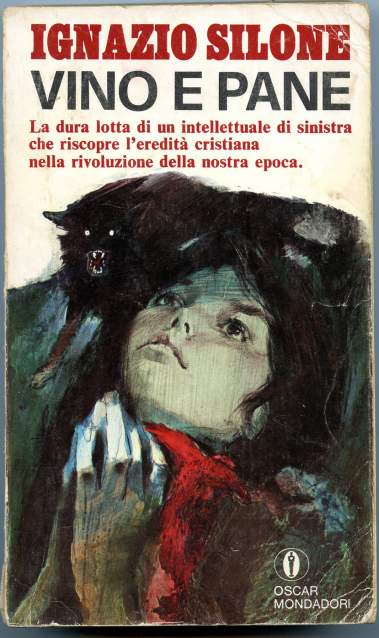
Vino e Pane – Ignazio Silone


One of the books that I got from my grandparents’ shelves (my granddad – despite oddly still remembering most of the first book of the Iliad by heart – is, well, rather “forgetful” these days, and a couple of years ago my grandma has made the rather commendable decision to only read newspapers).

Vino e Pane is a good book about Fascism and its impact on small secluded Italian hamlets. It’s also a book about Catholic piety and communist resistance (I favour one of the two, you can guess which one…) that is probably at its best when the two intertwine, like in the figure of the old Don Benedetto.

While the success that the book has enjoyed, in particular outside of Italy, is perfectly understandable, the quality of this work doesn’t match that of Silone's Fontamara or, for someone who has spent years reading books about Fascist Italy, of most of the works of Fenoglio, Vittorini, Malaparte, Levi, Revelli… So while I’m glad I’ve read it, Vino e Pane doesn’t really crack the top-10 of my favourite novels about the Italian resistance.  

Wednesday, 3 August 2016

It’s a Battlefield – Graham Greene

What a bizarre Graham Greene novel, and surely one that, had it not been for the wonderful place that was Books for Free in Stratford, I would have never picked up…

Out of all the books by Greene that I have read, this is the first one to be set in England (yes, I know he wrote plenty of other novels set here, I just haven’t read them…). Despite being familiar with so many (almost all?) of the corners of London that he describes, I found these to be so far away from me because of their perceivable bleakness and eeriness.

It’s a Battlefield is an extremely interesting book, despite the fact that all the important characters are not just unlikable, but fundamentally plain awful (and rather miserable). However, it’s quite a shame that Greene never gives Drover a chance to speak ( after all the prisoner is by far the most enigmatic and interesting character in the novel, with his attempted suicide after avoiding a death sentence being one of the best plot-twists I’ve ever come across) 

Sunday, 27 September 2015

The Postman – Antonio Skármeta


A novel that I bought with my dad as a Christmas gift for my mom (the only book I ever recall buying in a supermarket and not in a bookshop). I still remember my dad explaining to me that Massimo Troisi, the actor who played the titular postman in the movie taken from the novel, was a wonderful artist who died right after finishing the film.

When I read it as a teenager the book made want to get into poetry. I obviously tried with Neruda first, then followed it with the Poètes maudits, Pessoa, Lorca, Kavafis and many others, but to no avail. I was probably too shallow for poetry back then. I should try again, but I’m afraid I’m not much deeper than I was back then.

Skármeta’s novel is about Chile, about its most illustrious poet (Neruda, clearly), and about the poetry of the everyday life of the Chileans. There are plenty of novels in which important historical figures mentor some young and uneducated locals, and they often run the risk of becoming trivial. This novel avoids that. Mario, Neruda’s postman, does not evolve into a luminary of the literary world, and probably this is the reason why the novel isn’t banal, just touchingly beautiful. If at first his inability to express his feelings and the need to recur to Neruda’s poems is a bit too Cyranoesque, some of Mario’s simple thoughts are actually reflections of very serious issues, both political and literary (after all, does poetry belong to those who write it or to those who use it?).

Monday, 21 September 2015

Darkness at Noon – Arthur Koestler


Another book that I just wish my students would read: because it’s beautifully written, because it’s true, because it was published during the Second World War. Luckily, my students prefer reading The Hunger Games (when they read).

Darkness at Noon was defined by my boss’s boss as “not exactly a bundle of joy”. Rarely has a definition been more fitting. But it’s not just that, it’s also a great book. Despite a fairly good awareness of the history of the purges, the novel is still surprising: the way in which the contrasts between old and new party members, and between the upper echelons and the rank and file of the party are portrayed is absolutely astounding for the insightfulness. 

The hearings make the reader want to scream for help. And the fact that even characters like Ivanov cannot be sure of their own position within the party is an eerily frightening reflection of one of the darkest pages in 20th century history.

Tuesday, 15 September 2015

The Quiet American – Graham Greene


The first Graham Greene I’ve read. The one that made me wish I could teach a course based on his writing about the early Cold War. Surely most historians of the Vietnam War probably cringe at the mention of a “Third Force” theory, but the book was written in 1955 and its insight is undeniable.

The book is about rich white Westerners playing god in the rest of the world (something we normally do oh so well…). Despite the fact that it’s clear that neither Fowler nor Pyle will die when they find themselves in the watchtower, those pages remain incredibly gripping and tense. Again, nether one of the two is likable – yet the reader (or, at least, the European leader) wants Fowler not just to survive, but to be happy wherever he is, be it Vietnam or the UK.

I am sure in real life Graham Greene must have been a snobby and stand-offish arrogant bore, but man could he write…

Sunday, 13 September 2015

Animal Farm – George Orwell


Another book we read in our English class for the linguistically challenged in Canada. It led to wonderful class discussions about “Esnowball” (most of our classmates where native Spanish speakers) and his leadership skills.

I understand why this book was a great read at the time of its publication and for years to follow, but I think it’s now simply too dated (that being said, it should still be read because of its historical value, because its prose is beautiful, and because reading such a short book can give non-readers a much-needed boost).

Also, I’m not a fan of allegories. And, being a historian, the book didn’t really have many surprises for me (although you don’t need to be a historian to feel this way, clearly). So yeah, everyone should read this book for what it meant, but without expecting his/her mind to be blown away by a unique, cutting-edge and insightful critique of the Soviet system.