Showing posts with label Kunzru. Show all posts

Friday, 10 November 2023

Red Pill - Hari Kunzru


For once, I actually picked up a hard copy book from the Southwark Library (mostly out of surprise for seeing a couple of Kunzru titles in a library that is otherwise not crazily well-stocked, and that's obviously an understatement). 


Unfortunately this was my least-favourite Hari Kunzru novel. The dystopian present setting plus mental breakdown reminded me a bit too much of a relatively disappointing Paul Auster novel. 


I also thought that the autobiographical writing was one of the great problems with wanna-be writers, but ultimately there are too many aspects of Red Pill that appear too reflective of Kunrzu's life. I just hope for his own sake he's a bit happier than this literary alter-ego of his. 

Wednesday, 19 July 2017

White Tears – Hari Kunzru


A random advanced proof copy that my mom managed to find at the Blackheath Amnesty International book sale. Go mum!

Long chunks of this Kunzru novel seemed to be written by, erm, Paul Auster. Seriously, the feeling of alienation was very much the same. Despite the mixed reviews it seems to be receiving, I quite enjoyed White Tears, probably because it deals with white kids who try to adopt black culture with, in their own way, profound respect and self-criticism.

But in all honesty the gory end is just a bit much, and I could have done without the Charlie Shaw takeover – just a bit too (dark) magical for me…

Friday, 26 February 2016

Gods Without Men – Hari Kunzru

The great thing about young writers is that you can be all smug and unreasonably proud for reading their complete works, or at least all their fiction books (as it’s the case for me and Kunrzu). Let’s just ignore the fact that at the end of the day Kunzru has only written four novels so far.

To me, nothing will ever equal the impact and the depth of My Revolutions, but Gods Without Men was a lot more enjoyable than The Impressionist (I liked it pretty much as much as I liked Transmissions, with the sentimental sections in this case replaced by wacky but entertaining mystic ones). The book has been compared to works by David Mitchell and Kurt Vonnegut, but I actually saw quite a lot of Philip Roth (American Pastoral) and Don DeLillo (White Noise).

As usual, Kunzru writes beautifully, and succeeds in making the story of Jaz and Lisa gripping and touching (In particular when he describes their lives in the public eye). However, I have the feeling that some of the characters are slightly too stereotyped (in particular the nerdy Jaz and the British Nicky, who just uses a few British idioms too many to be fully credible). 

The mysteries of the afterlife don’t interest me. Kunzru’s recounting of them, however, does. 

Thursday, 24 September 2015

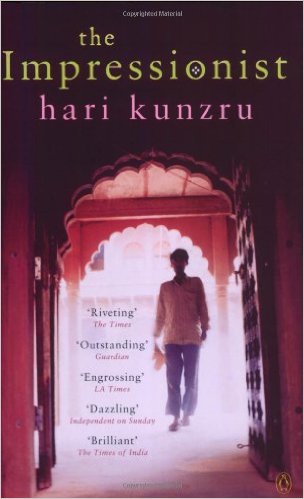
The Impressionist – Hari Kunzru


Another 30p surplus copy that my wife bought at the Barbican library, and a novel that I later took on a research trip to Rome, where I would hit the archives in the early morning, hit the city in the late afternoon, and hit the bed of a centrally located convent (yes, I wasn’t swimming in money as a Ph.D. student!) with a book or a movie in the (very) early evening.

I’m not quite sure if I was upset with myself for not liking a book by Kunzru, or kind of upset with him for writing a book that I couldn’t like. I had very high expectations from the book right after reading of Pran’s conception (in its biological rather than literary meaning) and getting ideas about the kinds of reactions that his complexion could cause.

But, sadly, the novel was a bit vacuous (like Pran himself) and never really won me over with its description of idealized and glorified places (which, to me, remain very much idealized and glorified even when they are deprecated in the novel). I just felt like Woody Allen’s Zelig was a much more interesting (and likeable) chameleonic character...

Tuesday, 15 September 2015

Transmission – Hari Kunzru


The third Kunzru novel I’ve read, something considerably more light-hearted than My Revolutions but still really enjoyable. Both in literally and touristic terms, I’ve never really felt the pull of the Indian subcontinent with its charm and its mysteries – yet this book, split between India, the US and the UK, made me reconsider that.

Arjun, the novel’s main character, is so adorably ill-equipped to face the world that you just want to reach out to him through the pages and hug him. Most people who have left home to find work have probably faced some similar misadventures (I surely have) – but probably very few have had so many. The ease with which Kunzru portrays the challenges of life in India, in the UK, and in the USA are probably a reflection of his own life experiences between the three countries (and continents)

Many have tried to write modern love stories in the internet age, but very few have done it with the light touch of Kunzru, who in many ways also preceded the writers of The Big Bang Theory (seriously, some traits of Arjun’s personality really remind of Raj).

Saturday, 5 September 2015

My Revolutions – Hari Kunzru


Hari Kunzru signed my copy of the book, dedicating it to “a great interpreter” (claim to fame, yay!) after I translated a fairly embarrassing speech by a local politician at the same literary festival where I worked for Hanif Kureishi (and Paul Auster – those were the times...).

This book is an absolute gem. It touches all the right notes and it’s perfectly researched (mostly in the archives of the university where I work). It paints a very accurate picture of some incredibly tumultuous times and their lingering effects on the people who experienced them, or at least it seems that way for a kid who – at the end of the day – hasn’t really protested against anything since 2003 (when Iraq was invaded I thought chaining myself to the entrance gate of my high-school would have done some good – it quite clearly didn’t make a change on a global scale, and neither it did on a local one as I didn’t succeed in seducing the girl I was trying to impress with my radicalism at the time).

(Way) more people should read this book. Sadly (way) more people won’t.