Showing posts with label Revolution. Show all posts

Wednesday, 20 May 2026

Creation Lake - Rachel Kushner


Underwhelming. Well-written, obviously, but underwhelming. 

This is a fairly customary Kushner plot - with one woman very much going her own way regardless of the reader's (and society's) expectations. I don't think I've ever had a problem with her main characters being, in one way or another, dislikeable. But in this case Sadie (let's call her that, even if we are reminded time and again that it's not her real name) is not just dislikeable, she's uninteresting. 

Her occasional bouts of self-criticism are too cynical to feel like anything more than just a literary trope, her personalities are so many and so different that it ultimately looks like she doesn't have one at all, and the ending (with her Catalan buen ritiro) is actually pathetically trite (much like her realization that those "stars" that move are actually satellites and the potential for intrusion by powerful entities virtually limitless). 

Monday, 27 January 2025

Telex from Cuba - Rachel Kushner


Having discovered that Rachel Kushner's Italian translator is a lady I met, I decided to read another one of her books (and didn't have too many reservations about reading it in translation). 


While I greatly enjoyed the writing, I felt that the book spent too much time setting the scene and providing historical background - probably because I'm reasonably familiar with the history of the Cuban revolution, partly because I teach about it, partly because I have watched The Godfather Part 2...

Still, once the plot "gets to the point" the book shares a number of similarities with many of my beloved suburban middle-class American novels, and that's a huge selling point. Also, it ultimately does a really good job of explaining how monoculture in general (and United Fruit in particular) messed up a country and its people. 

Monday, 20 February 2023

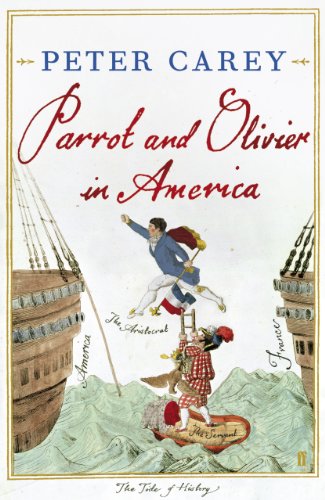
Parrot and Olivier in America - Peter Carey

 9780571253296: Parrot and Olivier in America - Carey, Peter: 0571253296 -  AbeBooks 

I thought that Peter Carey could make the life of 19th century French aristocrats interesting to me. I was wrong. In fact, he didn't even make it readable, as the book was an overlong slog. 

The best thing in the novel was the artwork on the cover page, but I doubt that it was down to Carey himself...

Or maybe the best thing in the novel was the fact that I only spent a couple of pounds on it in one of my last Fopp sprees?

Monday, 7 December 2015

The Honorary Consul – Graham Greene


Greene considered this to be one of his best works (at least according to Wikipedia – and who am I to question this claim?). However, in all honesty, I disagree: The Honorary Consul is enjoyable, but doesn’t have the suspense of The Quiet American or the hilarious turns of Our Man in Havana.

To me, Dr Plarr is simply too British to have spent his entire life in Latin America, and his constant remarks on “machismo” seem like those of an outsider rather than those of a self-critical local. Also, in a novel in which so many characters are fighting for their lives, I found it weird that not a single one of them was actually bad: Plarr and the desperadoes have their heart in the right place – although the latter have no methods – Fortnum is just a poor nobody, Colonel Perez is a good policemen who knows his people, and hell, even the British diplomats and politicians seem to be sensible. Only the General is probably bad, but he is only mentioned and doesn’t appear in the novel…

The book does pick up from the moment of the attempted creation of an Anglo-Argentine club, but to me it was too little too late.

And for someone who doesn’t really go to church, the lengthy discussions on God are just fairly painful and trite (and a reminder of high-school philosophy debates…)

Monday, 21 September 2015

Darkness at Noon – Arthur Koestler


Another book that I just wish my students would read: because it’s beautifully written, because it’s true, because it was published during the Second World War. Luckily, my students prefer reading The Hunger Games (when they read).

Darkness at Noon was defined by my boss’s boss as “not exactly a bundle of joy”. Rarely has a definition been more fitting. But it’s not just that, it’s also a great book. Despite a fairly good awareness of the history of the purges, the novel is still surprising: the way in which the contrasts between old and new party members, and between the upper echelons and the rank and file of the party are portrayed is absolutely astounding for the insightfulness. 

The hearings make the reader want to scream for help. And the fact that even characters like Ivanov cannot be sure of their own position within the party is an eerily frightening reflection of one of the darkest pages in 20th century history.

Sunday, 13 September 2015

Millennium People – J.G. Ballard


Offensively useless. Why would anyone read about a fictional uprising in Chelsea? I mean: Chelsea, of all places?!? Maybe the book targets an upper middle class that is looking for portrayals of its destructive power and potential (or maybe not: the quote on the front cover comes from the Daily Mail), but why this should be considered interesting is just beyond me. This is a pathetic excuse for a sensational book. I’ve never read anything else by Ballard. And I simply never will. Life is too short to read stuff like this.

Saturday, 5 September 2015

My Revolutions – Hari Kunzru


Hari Kunzru signed my copy of the book, dedicating it to “a great interpreter” (claim to fame, yay!) after I translated a fairly embarrassing speech by a local politician at the same literary festival where I worked for Hanif Kureishi (and Paul Auster – those were the times...).

This book is an absolute gem. It touches all the right notes and it’s perfectly researched (mostly in the archives of the university where I work). It paints a very accurate picture of some incredibly tumultuous times and their lingering effects on the people who experienced them, or at least it seems that way for a kid who – at the end of the day – hasn’t really protested against anything since 2003 (when Iraq was invaded I thought chaining myself to the entrance gate of my high-school would have done some good – it quite clearly didn’t make a change on a global scale, and neither it did on a local one as I didn’t succeed in seducing the girl I was trying to impress with my radicalism at the time).

(Way) more people should read this book. Sadly (way) more people won’t.


Friday, 4 September 2015

Demons – Fyodor Dostoevsky


A wonderful gift by a friend who, having to always have a different opinion from the rest of the world, told me that this should have been my first Dostoevsky book rather than Crime and Punishment, or The Idiot, or The Karamazov Brothers. 

It is clearly one of the best books I’ve ever read, although the fact that I've pretty much never read any other 19th century greats means I don't have much to compare it with. Nevertheless, it probably still needs more time to sink in, as my opinions and recollections fluctuate between awe for the incredibly insightful socio-political commentary, and slight boredom in the descriptive chapters at the start and the ones portraying the lives of either the rich or the poor people at the end of the second part and at the start of the third one

Most of all, I find it really perplexing that not a single one of the characters is actually likeable. Stavrogin is a spoiled little ass who only (barely) recovers towards the end with his suicide note, Stepan Trofimovich is just an intellectual loser (maybe I can relate, with my underutilized PhD and forgotten Cambridge MPhil?) and you just feel sorry for him but don't really like him, Pyotr Stepanovich is just downright scary, and Kirillov is by far the most fascinating character for me, but talk of creepy...