Showing posts with label Escape. Show all posts

Sunday, 17 December 2023

Last Night in Twister River - John Irving


Reading three hefty books by the same author over the span of a couple of months is too much, and it's probably partly because of that that Last Night in Twisted River is my least favourite John Irving book so far. 

In part, it's also because the main character (Danny) is ultimately quite dull if compared to the plethora of interesting people he is surrounded by (obviously his dad and Ketchum, but also Six-pack Pam, Jane, and his mother). He's an observer, overly-attached to his father, and doesn't really seem particularly able to take decisions and make things happen (rather, things happen to him). 

Also, I didn't quite buy into his becoming a great writer - too much of his writing is too auto-biographical and not inventive enough to suggest that he's someone who can encounter worldwide success. In addition, once the "cowboy" finds the two Baciagalupo, the story immediately loses momentum, and the long wait for Lady Sky is not enough to prop up multiple flat chapters. 

Tuesday, 18 July 2023

The Testaments - Margaret Atwood


Perhaps I should go back and read The Handmaid's Tale, as I recall liking it, but not as much as its sequel. 

From what I can recall, the former is a book about persecution, and the latter is a book about an escape. Both have tortuous attempts at rebellion at their heart, but the first novel is an agonizing one in which every page adds another layer of cruelty, while the second one is an action-packed page turner. 

In The Testaments Atwood doesn't seem to dwell as much on human cruelty - that was already explored more than enough in The Handmaid's Tale and often a quick hint to something allows even forgetful readers like myself to remember the sensation of oppression left by the first book. 

All in all, The Testaments is most likely the more enjoyable read, but The Handmaid's Tale is the better book. 

Monday, 10 June 2019

The Talented Mr Ripley - Patricia Highsmith


The fact that it took me almost a month to read this book is a sad representation of how little I am reading these days. But it will change over the summer, I promise! And then child number 2 will make me nearly completely illiterate, but there's still time for that as the due date is December 5th...

The Talented Mr Ripley is an absolute delight despite the fact that it's quite dated and, can one say "Orientalist" in its depiction of Italy? There are pretty laughable mistakes in the Italian sentences, the stereotypical descriptions are a bit over the top at times, and the depiction of Italian society is a bit superficial at the very least...

Yet the book is compelling, the reader wants Ripley to escape justice and have a half-decent life, and one is bound to think about how easily he would get discovered in the 21st century...

Saturday, 8 September 2018

The Mars Room - Rachel Kushner


Another of the Booker-longlisted IKEA books, and one for which I really wouldn’t have gone for had it not been for the fact that Don DeLillo was listed in the book’s acknowledgement. According to Oddschecker, it is now the second least likely book to win the award. In spite of that, it’s my own favourite for the year.

The Mars Room is a prison book that manages not to be bad, mean and aggressive. Yet, I believe it does give the reader an actual idea of the daily life in a woman’s prison. It is also about gender (and very much non-binary) and the challenges that women experience when facing unwanted male attention.

Yet again, for interesting that the above things are, what resonated the most with me is the hopelessness of a mother who doesn’t want to accept the reality of having lost her child.

Friday, 6 July 2018

The Underground Railroad - Colson Whitehead


The last in a (short) series of books by black writers that I've read at the end of the spring, and the one I liked best together with Citizen.

Having outgrown magical realism - or at least thinking I have - I was afraid that the decision to turn the underground railroad into an actual railroad would have been too much, but instead it was done in such a way as to give a scarily thrilling impression of the experience of former slaves going from station to station.

So many passages are beautifully written, and even without being a historian you can guess that until Cora gets to the North she's never going to be safe in any state no matter how stable the situation seems to be (from that point of view, South Carolina almost made me gag).

Possibly the most enjoyable chapters were the ones dedicated to the side characters that break the narrative of the main story - and I actually came to the conclusion that the only one who ever felt truly free was Mabel, Cora's mom, in those fleeting moments outside the plantation.

Friday, 29 September 2017

The Year of the Hare - Arto Paasilinna


I’ve only really read this book because my wife found a copy of it looking for a good home in our building’s lobby. Having read another book by Paasilinna (meh…) I decided to give his magnum opus a chance (and for once I use a Latin term, just because I find it funny to refer to a book like this in pseudo highbrow words).

This book somehow managed to be a best-seller in both Finland and the rest of Europe. And I really struggle to see why. As a funny book, it’s not funny (or at least not funny for me, but then again maybe I lack a sense of humour). As a deep book about discovering one’s true self, it’s really not deep. At most I can see it being reasonably cute for a cute book. But that’s about it. And I really don’t do cute.

And I am worried about the state of world literature if books like this are hailed as something that “will have you laughing and gasping by turns. . . . The writing is as spare and clean as the lines of Scandinavian design. . . . Of the many lines in this book that I cherished, the last is one of the most delicious: ‘Vatanen is a man to be reckoned with.’ So is this book.” The review came from Lonely Planet – I am afraid backpackers might be too worried about expanding their horizons to bother actually expanding their culture. 

Wednesday, 5 April 2017

Coming up for Air – George Orwell


Despite really liking 1984 (I was about to write “enjoying”, then realized it wasn’t the best of terms for the book!) I’ve never really been a fan of Orwell. Honestly, I’ve only read this book because a few weeks ago I picked up Penguin’s complete Orwell novels.

Turns out, I really did like Coming up for Air too. After the first few pages on the dullness of the main character’s life I thought I was in for another Keep the Aspidistra Flying (and that would have been a big, big disappointment), but I was wrong and this book is quite a lot more than that. The bleakness of the setting actually reminded me of Graham Greene’s It’s a Battlefield, and the novel is overall remarkably insightful in its observation on the impending Second World War.

I enjoyed both the flash-backs and the present-day narration, but the one issue I had was with the main character’s disillusion with the present and his attempts to go back to the good old values of early 20th century rural England, because more often than not that’s the kind of person that would very much like to see me leaving the country. 

Monday, 23 January 2017

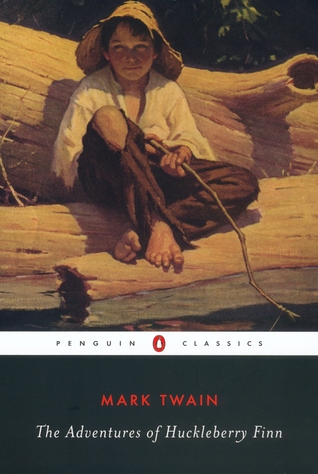
The Adventures of Huckleberry Finn – Mark Twain

A book that I’ve had on my shelf for ages (clearly!). And, to be honest, had I also owned a copy of The Adventures of Tom Sawyer I would have probably started with that (which would have been a bad call, considering that I quickly came to dislike Tom Sawyer in this novel).

Am I at ease with the way in which Jim is portrayed? Not always.

Do I think Huckleberry really escapes civilization? Not fully, just see so many of his moral dilemmas regarding Jim’s future (and past).

Do I think this is a work of art? Absolutely.

Huckleberry Finn combines the sense of adventure of the best Verne, Stevenson and Conan Doyle with what is ultimately a great moral depth (sure, so many of the comments on slavery make – and well they should! – people cringe, but it’s undeniably a step in the right direction for late-19th century white Americans).

But, to go back to my first few lines, I honestly disliked Tom Sawyer a lot – and I think that all the ordeals he made Jim go through in the last few chapters were just too mean, gratuitous and so not funny. So, despite liking Huckleberry Finn so very much I am not going to read The Adventures of Tom Sawyer anytime soon…

Saturday, 19 March 2016

The Master of Petersburg – J.M. Coetzee


A book I had never heard of and that I picked up among the remainders in the holy Waterstones on Torrington Place because a) it was cheap, b) I have plenty of money from the National Book Tokens to spend (thanks to a particularly thoughtful boss), c) I loved Disgrace by Coetzee, d) I loved Dostoevsky’s Demons.

The thing is, I liked the idea of the novel way more than I liked the novel itself. I found Coetzee’s usually wonderful prose too cumbersome here (of course, he has to give voice to Dostoevsky!), felt that all the characters (including Dostoevsky himself) were rather uninteresting, and just struggled with those 200-odd pages of divagations on life and death.

Clearly this book has made me want to read more Dostoevsky (which I probably will during the Easter holiday – I need to do it outside of term-time otherwise I won’t be able to focus sufficiently to understand his deep message, or even just the Russian names!), but to me it was just a novel with great premises and a (predictably) underwhelming development.

Wednesday, 27 January 2016

A Brief History of Seven Killings – Marlon James

A book that my boss lent to me to re-establish my faith in the Men Booker Prize after I was forced to read an absolutely pathetic novel – Anne Tyler’s A Spool of Blue Thread, which had been shortlisted for the prize last year – for my office’s book club.

I read the first 100 pages of this book with the same ease with which I had read the opening chapter of The Sound and the Fury (i.e. not a lot, being constantly lost in a prose that was simply too challenging for me), but after that rough start Jamaican Patois started to make sense, at least relatively.

Two characters stood out for me: the girl who runs away from Kingston (whose internal monologues felt like they had been written by Zadie Smith, despite the fact that the very end of her story is rather predictable) and the deceased politician who concludes most sections of the book (his description of the Singer’s illness and death is one of the most beautiful pieces of literature that I’ve read in a while). I didn’t find the book’s violence to be as Tarantino-esque as many reviewers presented it to be. Actually, I found the book violent, but not that violent.

Being nearly 700 pages, at times I felt that James could have got to the point more quickly, but then again he was probably doing it on purpose to offer a more vivid picture of the modus operandi (or vivendi?!?) of Jamaican gangs.

Most of all, the book is a wonderful display of how much impact one musician (the Singer is – surprise! – actually Bob Marley) has had on the life of his own country. It’s also kind of funny to see Marley always mentioned as “the Singer” while Peter Tosh and Jimmy Cliff are called by their names.

Also, because of this book I’ve spent the last 24 hours listening non-stop to the soundtrack of The Harder they Come

Friday, 18 September 2015

Il Barone Rampante – Italo Calvino

Easily my favourite book from Calvino’s Ancestors trilogy, and not just because a group of artists from my hometown decided to give Cosimo the burial he deserved, and placed a tombstone on a tree in the woods (they did the same for many other fictional characters whose burial places are not known – Anna Karenina, Obi Wan Kenobi, Roy Batty…).

The story is clearly implausible, but not completely absurd: after all every kid at some point wanted to just leave his/her family and go live on a tree (except that every kid would then decide to come back down within 15 minutes and not end up spending the rest of his/her life up there). The book is sweeter than the other ones of the trilogy, probably because Cosimo is actually a character to whom the reader can relate, unlike Medardo and Agilulfo.

Being confined by his desire to only live on trees without ever again touching the ground, Cosimo actually manages to win the hearts of Napoleon and the Tsar, of Rousseau and the people of his village, and, ultimately, also of the readers. 

Saturday, 12 September 2015

La Compagnia dei Celestini – Stefano Benni


Another book by Stefano Benni. This is actually a novel and actually quite a proper one, for funny that it is.

Forget about quidditch, this book sees the introduction of the best fictional game ever: pallastrada (it could be loosely translated as streetball in English, but it has no relation to pick-up basketball). Not even the author actually fully understands the rules of the game, which seem to be in constant flux (although it has to be played on any kind of surface except for grass, the pitch needs at least a part of gravel, a hurdle like a tree of a rock, be on a slope, and possibly in a place where the ball gone out of bounds can roll away for miles – no player can be subbed out until 60% of his/her/its legs are covered in blood).

Yet, despite the hilarious play-by-play reports, the book is also quite deep: it ironically discusses the stories of the humblest Italian boys, it portrays an evil national oligarch years before the final rise to (political) power of Berlusconi, looks at the idiosyncrasies of the Catholic Church (and its head, the “great meringue”) and it is overall an allegory of the fight between good and evil (although its description of the German pallastrada team might not be particularly politically correct).

In short: this is just a great book.

Tuesday, 8 September 2015

Il Fu Mattia Pascal – Luigi Pirandello


One of those books that Italian students are forced to read (and hate) in their final year of high-school. Luckily I had left for Canada by then, and only read Il Fu Mattia Pascal well after the end of my Ph.D. I wouldn’t say that I loved it (nobody in his/her same mind could love this book), but I did definitely enjoy it more than what I expected.

Much of the book is set in the towns on the Italian Riviera where I used to go to when I was a kid, and I loved that. Despite the fact that, like pretty much every other Italian, I already knew the plot and at least a number of its twists, the book was still a nice read.

And call me romantic (something which I’m really not), but I like the fact that book goes full circle, and that the main character ends up feeling the call of his own hometown.