Books I've read. Books that have had an impact on me. Books that didn't, but that many believe should have.
Showing posts with label Adventure. Show all posts
Sunday, 10 June 2018
Monsignor Quixote - Graham Greene
And this is the reason why I was saying that I've probably read too many Graham Greene. Despite the quote from a review from The Spectator on the book's cover, the novel is not Greene's best, or the most absorbing, or adept - it is possibly his most effortless though, as it costs the reader nothing to read it, but I'm afraid it also cost Greene very little to write it.
I probably (well, surely actually) didn't like the picaresque tone of it, but with this I'll probably stop reading Greene novels no matter how much I've loved so many of them*
* That's a blatant lie, I might stop after reading The End of the Affair.
Wednesday, 5 April 2017
The Count of Monte Cristo – Alexandre Dumas
With my wife and baby daughter gone for six weeks (!!) I
decided this period was my best chance to read the thickest book I had on my
shelves.
The Count of Monte Cristo
is one of the most gripping books I’ve
ever read – parts of it reminded me of Stevenson, others of Verne, and I
suspect quite a few would have reminded me of Hugo (this remains only a
suspicion because, erm, I’ve never actually read any Hugo). The vendetta is at
times a bit too prolonged, and I would honestly differentiate between the degree
of guilt of Fernando, Danglars, Villefort and Caderousse, but I don’t really
hold Dantès responsible for the death of young Edourad de Villefort
(much like Indiana Jones in Raiders of
the Lost Ark, Dantès plays no role in the outcome of this subplot).
However, for spellbinding that the book is, I really don’t
think this is great literature. It’s honestly just a bit too easy to read and
to follow (the only intimidating thing being the thickness of it in the end), I
never got even remotely confused by the plot or by the characters in it. As one
of my colleagues rightfully said, it’s probably just a book that used to be
low-brow and that is now considered to be high-brow because of the passage of
time and historical setting.
Thursday, 16 February 2017
Watership Down – Richard Adams
When I rescued this book from the “table of unwanted items”
in my building it was more beaten up than Bigwig after his big showdown with
General Woundwort. It was worth rescuing it. Not that, unsurprisingly, its
state improved after being put in my bike bag and taken to work every day this
week!
As an adventure book Watership
Down is just great. It’s got tales of heroic bravery, suspense and
friendship. From that point of view it ranks up there with Treasure Island, Around the
World in 80 Days and The Lost World in
terms of children’s (or at least young adults’) literature. The problem,
though, is that, even in this case, I could have really done without magic and
folklore: I didn’t care for the stories passed down from generation to
generation of rabbits, and I would have liked Fiver a lot better had he not had
extra-sensory perception!
Sure, only bucks appear to have a prominent role and does
take very much the back seat, but I really don’t see it as too much of a
problem and I don’t read too much of a macho message into it (maybe because I’m
a man!).
Monday, 23 January 2017
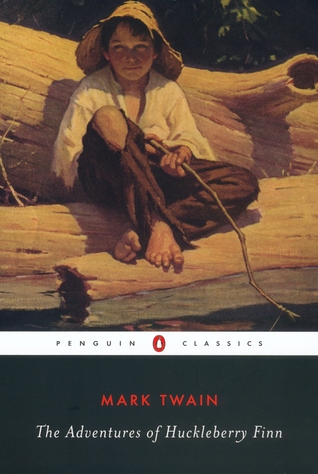
The Adventures of Huckleberry Finn – Mark Twain
A book that I’ve had on my shelf for ages (clearly!). And,
to be honest, had I also owned a copy of The
Adventures of Tom Sawyer I would have probably started with that (which
would have been a bad call, considering that I quickly came to dislike Tom
Sawyer in this novel).
Am I at ease with the way in which Jim is portrayed? Not
always.
Do I think Huckleberry really escapes civilization? Not
fully, just see so many of his moral dilemmas regarding Jim’s future (and
past).
Do I think this is a work of art? Absolutely.
Huckleberry Finn combines
the sense of adventure of the best Verne, Stevenson and Conan Doyle with what
is ultimately a great moral depth (sure, so many of the comments on slavery
make – and well they should! – people cringe, but it’s undeniably a step in the
right direction for late-19th century white Americans).
But, to go back to my first few lines, I honestly disliked
Tom Sawyer a lot – and I think that all the ordeals he made Jim go through in
the last few chapters were just too mean, gratuitous and so not funny. So,
despite liking Huckleberry Finn so
very much I am not going to read The
Adventures of Tom Sawyer anytime soon…
Tuesday, 6 December 2016
Treasure Island – Robert Louis Stevenson
One of the books I postponed reading for, well, about 19
years. The first 4 of those years were because I didn’t feel like reading
anything anyway, the following 15 because why reading a book when you already
know the story and you are afraid of getting Jethro Tull’s Mother Goose stuck in your head as you read it (“Four and twenty
labourers were labouring, And digging up their gold, I don't believe they knew
that I was Long John Silver”)?
Well, turns out that you should read this book despite the
fact that you already know how it will end because it’s possibly the greatest novel
ever written. It combines the sense of adventure of The Lost World or 20.000
Leagues under the Sea with a plot that is ever so slightly less improbable,
and Stevenson’s prose is unparalleled – meaning that for me the book ranks up
there with Around the World in 80 Days.
As far as bad guys that are actually (maybe possibly) not
so-bad (and may have fallen on hard times so might deserve our understanding)
Long John Silver is second to none, despite the fact that the narrator is a bit
of a know-it-all.
I am not that familiar with contemporary fiction for
young-adults, but I really don’t think there is anything that could come even
remotely close to this.
Wednesday, 20 July 2016
The Lost World – Arthur Conan Doyle
When I was a kid I read some of Sherlock Holmes’s stories
and kind of liked them, but to me The
Lost World was of an entirely different calibre.
Maybe it’s because this week I’ll be going to Crystal Palace
to check out the 19th century dinosaur sculptures, or maybe because
the novel reminded me of my youthful love for those creatures, but I loved The Lost World with passion. Sure, the characters are all so
representative of authentic 19th century English values (something
with which I am still very much struggling in post-referendum Britain), and
many of these features are just offensive by today’s standards (nowadays you
don’t quite assert your masculinity by firing guns, at least in theory, and
women are allowed on adventurous expeditions, at least at times), but the four
heroes all remain charming in their own ways.
I suspect that the book falls into the “young adults”
category – and I’m sadly out of it now! – but one thing that really surprised
me is that, at the end of the day, it’s really not dated…
Monday, 26 October 2015
Michael Strogoff – Jules Verne
My grandma taught me how to read when I was 4. By the time I was 5 I was
a boring kid reading scientific publications on dinosaurs and wild animals. By
the time I was 6 and in elementary school most people around me had also
learned how to read, so I stopped and, essentially, didn’t open a book until I
was 14.
Because of my long literature-free years, I am now often forced to
embarrassingly catch up on books that I wish I had read in my early teens, like
Michael Strogoff. I half-heartedly read
20.000 Leagues under the Sea when I
was 12 (one of the few books that I was forced to read in that period and,
because of the mood I was in, I think it’s best if I don’t write anything about
how I felt towards Captain Nemo then), I later loved Around the World in 80 Days, but Michael Strogoff was the Jules Verne book that intrigued me the
most (that said, I managed to postpone reading it until now although I had
asked for it as a Christmas present probably 10 years ago).
It was a delightful read despite the fact that, more than Around the World in 80 Days, the novel
is so extremely dated (its national stereotypes, its depiction of women,
nationalism, courage, morality etc.) – but my edition still had the old 19th
century illustrations which made me tingly inside, and I must say I actually
had goosebumps when Michael carries Nadja towards Irkutsk. It was also
interesting to look at how quickly each event was described: with one hit
Michael kills a bear, with one jump he runs away and so on and so forth – all those
actions are described in one quick line, whereas in a 20th century
adventure they would probably last for a few epic pages.
Also, I’ve probably loved the book because it finally gave me an idea of
the geography of some of those mysterious territories in the top-right corner
of the Risk board…
Monday, 28 September 2015
Puerto Escondido – Pino Cacucci
I read this book after watching a travel
program on Mexico in which Cacucci was gallivanting around the country with a
couple of Italian comedians. Now that I think about it, there isn’t much to say
about the novel: it’s just a series of wacky adventures that lead the main
character to end up in the Mexican village of Puerto Escondido.
It’s just that – not a masterpiece, not a work
of great literature – but it’s absolutely lovely, and isn’t this what reading
(at times, not always!) should be about?
Thursday, 17 September 2015
Around the World in 80 Days – Jules Verne
When I was a kid, I didn’t really read. Which
meant that by the time I was 14 or so I had to catch up on the books that a
good reader is meant to have read in middle-school. I read this novel while on
my bizarre first holiday, in Venice and with a friend of mine who was somehow
not interested in visiting every single church and museum in the city (I was
really boring when I was 14, probably more so than I am now...). Surprisingly,
our friendship has never been the same since...
This book surpassed my expectations. By a lot.
For a few days I wished I was Passepartout and had a side-kick as nice as
Phileas Phogg (sorry, that’s the pecking order for me...). And the end of the
novel, with the incomprehension regarding time zones, is still absolutely
priceless.
I really wish I could go back in time and force
11-year old me to read this book then. However, if I had to pick only one book
to force-feed to my younger self, it would probably be the one above...
Saturday, 12 September 2015
Heart of Darkness – Joseph Conrad
I read this book while playing spot the
difference between the novel and Apocalypse
Now. That was fun. I had already realized that Conrad’s writing is not
dated, but this book confirmed it. True, there are passages that are fairly
dull, mostly in the lead-up to the actual expedition up the Congo, but this is
understandable if not expectable.
The novel is still unsettling, probably like Conrad’s
life must have been. The fact that the boat is floating up the Congo and not
the Nung to me makes it even more obscure and mysterious. However,
I wish I had the liberty of picturing Kurtz and Marlow without the faces of
Brando and Sheen.
Also, it’s kind of a shame that there is no talk
of surfing in the book, but hey, you can’t have everything...
Sunday, 6 September 2015
The Shadow Line – Joseph Conrad
I always thought my first Conrad book would
have been Heart of Darkness – not sure
whether it was because that’s the one my high-school teacher was always talking
about or because I had my mind blown by Apocalypse
Now when I was 14. Instead, I ended up reading this first because it was
picked as one of the 103 (random number, I know) most significant books of the
20th century by the Italian newspaper La Repubblica – a wonderful
collection that no doubt inspired me to read more.
I assumed Conrad’s writing would be dated, but
at the end of the day if Verne’s adventurous stories aren’t dated for young
adults (and oh they aren’t), why should Conrad’s be for supposed-to-be real
adults? The Shadow Line is still a
surprisingly enjoyable book, with its journey of self-discovery not made any
less interesting by the passing of time.
Subscribe to:
Posts (Atom)