Showing posts with label Aristocracy. Show all posts

Tuesday, 7 May 2024

The Man in the Red Coat - Julian Barnes


Ok. This one is on me. The other week - short of ideas - I picked the first Julian Barnes book that was available in my Italian e-library. 

I read it was about the life of a doctor (Pozzi) whose portrait had been painted by Sargent and I mistakenly assumed this would be a work of fiction along the lines of Flaubert's Parrot. 

Instead it was a couple of hundred pages of pedantically detailed accounts of the lives of Pozzi, his family, and his circle of posh friends. Even the occasional humorous remarks by Barnes didn't hit the mark with me as I read this book while on auto-pilot, having lost all interest in it after a dozen pages. 

Reminder: maybe don't read reviews beforehand, but at least read a book's synopsis next time...

Monday, 20 February 2023

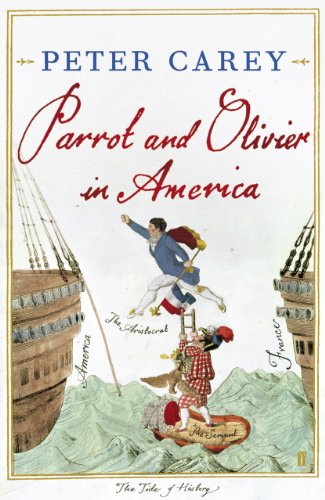
Parrot and Olivier in America - Peter Carey

 9780571253296: Parrot and Olivier in America - Carey, Peter: 0571253296 -  AbeBooks 

I thought that Peter Carey could make the life of 19th century French aristocrats interesting to me. I was wrong. In fact, he didn't even make it readable, as the book was an overlong slog. 

The best thing in the novel was the artwork on the cover page, but I doubt that it was down to Carey himself...

Or maybe the best thing in the novel was the fact that I only spent a couple of pounds on it in one of my last Fopp sprees?

Friday, 29 September 2017

Mother’s Milk – Edward St Aubyn

I had never heard of this author until my mom just forced me to invest 50p in this book of his at Surrey Docks Farm. As we all know, my mom is very rarely wrong (at least when it comes to literature, when it comes to playing cards with me that’s an entirely different story).

The first section of the book details extremely well a number of feelings that I undeniably felt right after the birth of my daughter (minus the borderline psychic older son, and some of Patrick’s self-destructive tendencies), but what is just great is seeing the odd dilapidation of an impressive family fortune in the following sections (one dedicated to every summer holiday of the main character, which I found to be a wonderful idea).

If Patrick’s complex family situation at first runs the risk of reminding the reader a bit too much of the kind of McEwan novels that have come to bore me, its spiralling out of control is actually closer to a more serious version of Jonathan Coe’s Winshaws – and that’s one of the reason why this novel is ultimately so enjoyable. The other reason, although this is far from being politically correct, is its shrewd treatment of people who age badly – not something I necessarily disagree with. 

Monday, 1 August 2016

The Remains of the Day – Kazuo Ishiguro

Having already seen (and loved) the movie, Ishiguro’s novel really had no surprises for me – but boy was it lovely…

From an historical point of view, Ishiguro does a remarkable job of highlighting how easy it is to be harsh on British appeasers in hindsight because of the consequences of their actions (personally, I think they were fools who thought they understood Hitler and his depravity, but they were also dealt a remarkably bad hand…). And, also, he describes how the patterns of international diplomacy (once the happy game of the chosen few who had moved in the same circles for centuries) changed between the wars as those positions became way more professionalized.

And as for Mr Stevens, much like Penny does with Sheldon in The Big Bang Theory (not the most cultural of references, I know), I wanted to hug him at times and try to explain things that are obscure to him (like banter…) in the simplest possible way.

Too bad that, yet again, I found myself thinking what those people would have voted for in the EU referendum…

Tuesday, 26 July 2016

According to Queeney – Beryl Bainbridge

Whenever one doesn’t know what to read, s/he can be sure that there is a short Bainbridge novel somewhere.

While not exactly the greatest book ever written (probably the sentence that I use most often in this blog…), According to Queeney is an interesting portrayal of Dr Johnson and his circle – and definitely something that one needs to read as s/he tries to act like a true Londoner (or a Southwark resident).

The start of the book is a bit bland, and the lack of unstable young women is somewhat disappointing for a Bainbridge novel (both Queeney and Mrs Thrale seem a bit too proper to me), but it does pick-up after their trip to France, and Queeney’s letters at the end of each chapter are a much welcome change in style every few pages. 

Wednesday, 14 October 2015

Saturday – Ian McEwan


I found an autographed hardback copy of the novel on the second-hand bookshelf at my local urban farm. It was selling for 1£. It says a lot about the value of literature these days...

The book is beautifully written. No wonder, it’s McEwan. The book is about rich people and their perfectly imperfect lives. No wonder, it’s McEwan. The book actually annoyed the hell out of me, which is a shame because, after all, it’s McEwan...

I’m not quite sure whether McEwan depicts a Henry Perowne that is irritatingly detached from reality or if that’s actually a reflection of the author’s outlook on life in London (the autobiographical elements in Saturday are clearly many and at times it’s hard to disentangle pure fiction from McEwan’s experiences).

The book annoyed me because Henry Perowne and McEwan seem to mock those who protested against the invasion of Iraq. I did back in the day, I’m quite proud of that, and I’m happy I carried those signs that he seems to find fairly meaningless. It annoyed me because I had little intention of spending half an hour reading about a stupid squash game. It annoyed me because during the squash game one of those supposedly average athletes in their 50s jumps “two or maybe even three feet into the air” (you’re either a real athlete, or you are delusional if you think you can jump that high with a couple of steps). Similarly, you don’t run a half marathon in less than an hour and a half if you’re little more than a casual jogger (trust me on that).

It annoyed me because the book hates on the student halls in Bloomsbury and Fitzrovia where I lived and worked for years. It annoyed me because, protected by his fancy car on Tottenham Court Road, Henry Perowne/McEwan thinks that everyone around him is fundamentally happy (the guy selling The Big Issue? The old lady diving for reduced to clear sandwiches at Tesco? The underpaid McDonald’s staff?). It annoyed me because, for all the medical research he’s had to do to write this book, Perowne’s mom has the same illness that Briony develops in Atonement (which he wrote four years before, without publishing any other novel in the meantime).

The novel’s greatest merit has been that of arousing something similar to a weird nationalist pride in me (something I’ve never possessed and that I hope I’ll get rid of by tomorrow morning). As an unknown Italian archaeologist impregnates Perowne’s flawless daughter, McEwan allows himself to label the Italians as pueri aeterni (eternal teenagers) and says that Italian men won’t get up in the middle of the night for the cries of their teething children. Screw that, I have a right to say those things if I want to. You, rich and pompous foreigner, don’t.

Sunday, 20 September 2015

The Age of Innocence – Edith Wharton


If I had no actual reason to be interested in the swinging lives of Scott Fitzgerald’s aristocrats in the 1930s, I surely also didn’t have any reason to be interested in the boring lives of Wharton’s aristocrats in the 1870s.

Yes, The Age of Innocence is beautifully written, but it’s just so incredibly boring! Between the end of the 19th and the beginning of the 20th century there were surely more pressing problems (see the post above) than the forbidden love between Ellen Olenska and Newland Archer.

Like Byatt’s Possession (although separated by pretty much a hundred years) this is a feuilletton I struggled with, but in both cases the last page made it (maybe?) worth it and gave the books worthy finales.

Saturday, 12 September 2015

The Emperor’s Tomb – Joseph Roth


I read this book without having first read Radetzky March, something which I now regret (slightly) but that still didn’t prevent me from loving this novel. And I didn’t just love it, I also used it in an essay about the relationship between architecture and memory that won the praise of my Cambridge professors (probably the only time that happened).

There is something in the classy decadence of the Austro-Hungarian Empire that is particularly appealing to me (and I don’t even come from the part of Italy that was under Austrian control for a long time). I’m not particularly at ease with the way in which Trotta treats his wife, but that probably (and sadly) is justified by his upbringing.

Oddly enough, this is another book whose details are now escaping me, but the final walk to Franz Joseph’s crypt is a wonderfully melancholic picture that I think will always stay with me.