Showing posts with label Sciascia. Show all posts

Monday, 28 September 2015

Il Giorno della Civetta – Leonardo Sciascia


I have already talked about three books by Sciascia, but I just wanted to add a couple of words about this one. I took it with me when I moved to Canada, because in our little international high-school we were often asked to discuss what was good and bad in our countries, and I felt that Il Giorno della Civetta was a perfect picture of both.

In the novel Sciascia paints the Sicilian mafia for what it is, without romanticising it and without indirectly praising its principles (and its violence). I was also fascinated by the fact that Sciascia wrote from the viewpoint of a policeman from Northern Italy, a decision that I found extremely bold for someone as Sicilian as Sciascia. Had this book been published ten years ago, I would like to think that it would have enjoyed more success than Roberto Saviano’s Gomorra, but it probably wouldn’t have been the case.

One could easily teach Italian history through Sciascia’s books, but again that’s a risk we’re not going to run anytime soon...

Thursday, 17 September 2015

A Ciascuno il Suo – Leonardo Sciascia


Copying and pasting the first line I used for my post on La Scomparsa di Majorana: Another great little book by Sciascia. In this novel Sciascia paints, with his usual realism, an accurate picture of the intrigues of a small town in Southern Italy, with its thirst for vengeance and the oppressive Catholic values (more oppressive than the Church itself).

As a reader, I felt proud of Laurana’s discoveries and intuition. Yet, since the character is an intellectual, I imagined that his aloofness would have been enough to ensure his safety. Clearly, being Italy and being a novel about an informal investigation on a mysterious murder, his safety might shouldn’t have exactly been taken for granted.

La Scomparsa di Majorana – Leonardo Sciascia


Another great little book by Sciascia. La Scomparsa di Majorana is a brief history of one of the greatest geniuses of the 20th century and his disappearance (one day in 1938 he was supposed to be on a ferry back to Naples but was never actually seen landing, and nobody heard from or saw him again). Ettore Majorana was one of the most gifted theoretical physicists of his generation, working side-by-side with Enrico Fermi, but also an enigmatic character (like most geniuses are, I suppose), shy, moody, and struggling to interact with other people.

In the book Sciascia highlights a number of the more or less plausible explanations that have been given for Majorana’s disappearance Sciascia seems to believe that Majorana, possibly worried by the dangers of the implications of his atomic discoveries, just decided to leave everything behind and start a new life somehow, somewhere. Maybe the author was a romantic who didn’t want to believe that Majorana had killed himself, maybe at sea, but a few months ago allegedly undeniable evidence has proven that the physicist was living in Venezuela in the 1950s, and that just makes me happy...

Monday, 14 September 2015

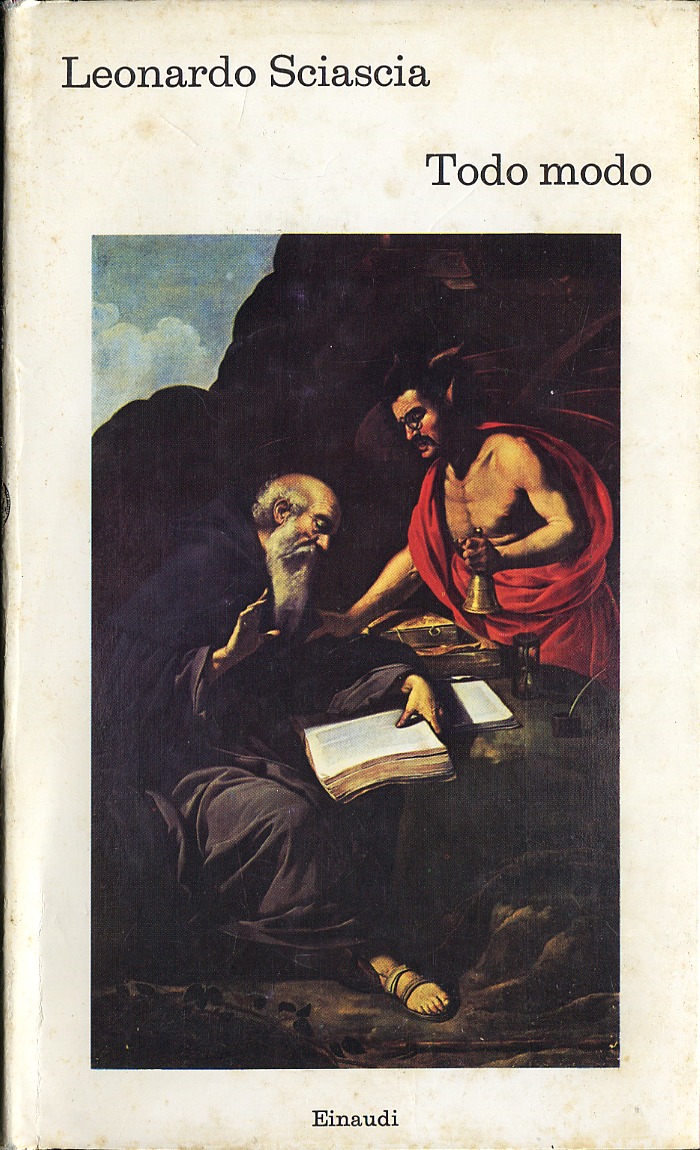
Todo Modo – Leonardo Sciascia


Leonardo Sciascia is a great author who, I am afraid, will soon run the risk of being forgotten (hopefully this is just because there is nothing further away from us than the recent past, but I’m afraid it is because we no longer care about novels on the social and political changes of the country in the mid-20th century – or is it even more worryingly that we don’t care about novels full stop?). If people are too lazy to read his books, they should at least watch the movie inspired by this book, directed by Francesco Rosi (who stood to cinema like Sciascia stood to literature), with probably the most famous Italian actor (Marcello Mastroianni, that Marcello), and with my personal favourite (Gian Maria Volonté).

This book criticized the Vatican at a time in which it was actually bold to do so, before the Catholic Church started running the risk of closing down and the Western world became increasingly secularized, a period in which popes were dying in rather mysterious circumstances and the sketchy Cardinal Marcinkus  was disposing of money (and probably people) with impressively suspicious nonchalance. The tension throughout the book is palpable, and it is alienating in a way that very few books of a hundred pages are.

I’d like to think that my generation fell in love with Dan Brown only because they weren’t exposed to Sciascia.