Books I've read. Books that have had an impact on me. Books that didn't, but that many believe should have.
Sunday, 10 June 2018
St Urbain's Horseman - Mordecai Richler
Oh, how long since I had last read a Richler novel. Sure, my former Canadian teachers presented him as an awful human being (years before my time there, he came to give a guest lecture at our school and left everyone rather unimpressed), but in terms of North American Jewish writers for me he's right up there with Roth and Bellow.
St Urbain's Horseman doesn't have the epicness of Solomon Gursky Was Here or the comedy and mystery of Barney's Version, but it remains an impressive book. Large sections of the book are set in a London that I don't find too drastically changed in nearly 50 years. The parts about the legendary horseman are wonderful portraits of Canadian life in the first half of the 20th century, and the idea of him looking for Mengele (though not even the narrator actually believes that, probably) are the work of a genius.
Without the Jewish elements I probably wouldn't have enjoyed this book this much. But the fact is, the Jewish elements are very much there and so, unsurprisingly, this book is a winner for me.
The Lost Honour of Katharina Blum - Heinrich Böll
I thought Group Portrait with Lady was too long and lost its magic in the final 50 pages. I now think that The Lost Honour of Katharina Blum is too short and never gets to have much magic in the first place.
As usual, this is a novel about ordinary German people in turbulent times, but either because of its shortness or because of the historical period (though, being Italian, I would have expected to find its take on German political terrorism in the 1970s more interesting), I found this book, for want of a better term, a bit "hmpf"...
And I am now leaving this post much like the book itself - short and a bit pointless
The Handmaid's Tale - Margaret Atwood
Luckily, even in my new job, there is a colleague who reads as much as me. This is the first of five books that she has lent me recently, and one that I enjoyed a fair bit (if one can actually "enjoy" this book).
I'm not excessively fond of dystopian novels, but I have to recognize that this is one of the finest examples. That said, never having been a woman, I'm afraid that a lot of its most disturbing passages don't really hit me as much as they would hit someone of the opposite sex (the ones about the loss of Offred's child, on the other hand, resonate a lot more with me).
I think the greatest demonstration of the fact that I'm not one for dystopian books (despite the fact that every instance of oppression the author describes has happened in history at one point or another) is the fact that, despite liking this book, I'm really in no rush to watch its TV adaptation.
Black Dogs - Ian McEwan
Blogging at 7 am because, well, why not when you have a wife in pain in bed and a daughter not in pain and very, very much out of bed.
I thought I was done with McEwan, but then the Shaw Library presented me with Black Dogs (my mom's favourite McEwan as far as I can recall) and I just grabbed it. And it simply reconfirmed my thoughts about the author: I've simply read way too many of his books.
Black Dogs is flawlessly written, like all of McEwan's books, but I cared so little about the post-war love story between its two main characters that for me it overshadowed the unusual setting of the novel (unusual in the historical era depicted, not that the French countryside is an unusual literary setting).
Friday, 8 June 2018
The Map and the Territory - Michel Houellebecq
The first book I've read since re-discovering LSE's Shaw Library, of which I'm probably the only user right now (between the fact that term has ended that the fact that, well, nobody really reads anyway).
Having never read any Houellebecq I knew that I had to give him a chance at some point. I was biased before the start, knowing that he's an arrogant reactionary ass, and with this book I discovered that he is all that, but also a genius.
It takes a boundless ego to put oneself as a larger-than-life secondary character whose aura can be perceived across the entire novel like Darth Vader's presence can be felt on the Death Star, and I think he had the time of his life describing the aftermath of his own murder, but the book is surprisingly deep in its reflections on the ageing process, in its handling of love, and crucially in its poignant descriptions of the art world (and the opening with Jeff Koons and Damien Hirst is just so incredibly good).
Labels:
Art,
French,
Houellebecq,
Life and Death,
Murder
L'Angelo di Avrigue - Francesco Biamonti
Reasons why I really, really liked the book:
- It was given to me by one of the few friends who give me books as presents, and who I don't think has ever gone wrong (though at the moment my baby daughter appears very attracted by the cats in a copy of Maus that she gave me years ago, and I'm not quite sure that's a good thing)
- It is about the region where the Alps dive into the Mediterranean, the place of many of my summer holidays
- It is about the lost souls who lose their lives for one reason or another on those mountains - and this is a time when desperate migrants try to make their way from Italy to France on those very paths
- It's written in a style that's halfway between Fenoglio and Izzo
- It has one of Cezanne's landscapes on its cover, those were the first works of art that I truly came to love as a kid, and this would have been enough by itself
Lucky Jim - Kingsley Amis
One can only go so many years in the UK without reading any Kingsley Amis. And one can only work so many years in a univeristy without reading Lucky Jim.
A couple of months removed from the book, I'm now wondering what I was left with after I finished it. Turns out, not so much - the fact that the academic world doesn't seem to have changed that much over the past 60 years is interesting but not particularly surprising, and as for the humour I'm afraid it's a bit dated (or maybe I should learn to refer to my colleagues as "old chaps" and try to be more quintessentially British?) and, at the cost of sounding blasphemous, I'd pick a lighthearted David Nicholls novel over Lucky Jim if all I need is a bit of fun.
A Universal History of Infamy - Jorge Luis Borges
At a time when I had virtually no books left to read at home, I started going back to my wonderful Meridiani (a collection of books presenting the complete, or at least the best, works of hundreds of authors in finely printed volumes) and picked up Borges.
Having only read a few of his short stories years ago (and having been left relatively unimpressed) I was happy to give him another chance, and so went for what is apparently considered as the first work of magical realism.
The short stories are curious and gripping, and knowing some of the characters discussed makes them more interesting. In the end I liked the book a lot more than I had expected, so much so that I decided to read another Borges straight afterwards - however, I limped through the first short story of the following book (The Aleph) and decided to put it back on the shelf, where it will probably remain for quite a while.
Sei Stato Felice, Giovanni - Giovanni Arpino
A book that I would have loved to love, because my name is in its title and because Arpino comes from my hometown, but one that left me remarkably unmoved. A shame considering that the author is the genius behind Il Buio e il Miele (the basis for the movie Scent of a Woman), but I guess Italian coming-of-age stories from that period, much like Fellini's I Vitelloni, are just not for me.
James Baldwin can rest assured - Giovanni's Room is still easily my favourite Giovanni-focused book!
How To Be Both - Ali Smith
And thus I discovered Ali Smith. At the tender age of 31 (me, not Ali Smith).
How To Be Both is easily one of the best books I've read this year, and we are at 29 so far. This has to do partially with the fact that it's a novel of two halves that can be read in whichever order, and what blows my mind is that it can actually really work like that. Another reason is surely the decision to focus on Ferrara, a city that I have great memories of visiting as a kid and one that I went back to a couple of years ago with great joy.
Oddly enough, despite the factually questionable stories of disguise in the Renaissance (though extremely interesting from a 21st century perspective) Smith doesn't give a sickening sweet and fake picture of Italy as so many authors do, and that's one of the novels' greatest achievements.
And it also made me want to go back to the National Gallery, the London museum that I have neglected the most over the past 8 years (though I probably spent enough time there in my first 4 years to make up for the prolonged absence).
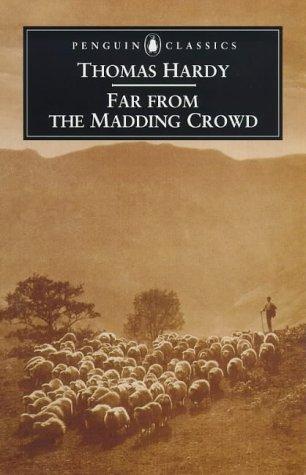
Far From the Madding Crowd - Thomas Hardy
Well, I was bound to be back at some point. Oddly enough, I've been reading my usual (large) amount of books but haven't blogged in months - I possibly have to blame fatherhood and a move in between, but hey.
At this point, I've read Far From the Madding Crowd months ago and it's already starting to get blurry in my mind, but what has definitely remained with me is the fact that, somehow, I actually enjoyed it.
Pastoral, romantic, bucolic, 19th century-esque and all, but, one way or another, I ended up liking it. Maybe it's because shepherd Oak is such a wonderful figure, or maybe it's because I have always had a tendency to be bored to death by 19th century novels in my native Italian, but have had fewer similar issues with authors from other countries.
This is not to say that I absolutely loved it, because it doesn't really speak to my heart for obvious reason, but it's a book that was granted the right to move to our new flat with us, an honour that during times of austerity (I'm allowing myself enough books to fill an IKEA bookshelf, but not more for lack of space) should be respected.
Wednesday, 14 February 2018
Il Caso Malaussène – Daniel Pennac
Well, it’s a French book but I’m using the Italian title
(that’s the language I read it in, and there is no English translation yet as
far as I know). My mother found this on the book exchange shelves of Turin
airport, which are very well designed and very rarely used (then again, on them
we found this, The Body of Jonah Boyd,
and some other interesting books over time).
I honestly thought I had outgrown Pennac, and that the magic
of the Fairy Gunmother and The Scapegoat could not be sustained
(hence why I haven’t read a number of its following books), but this one deserves
quite a lot of credit. Malaussene’s life in the 21st
century still makes sense (well, as much sense as the life of a former
professional scapegoat might make!) because Pennac’s prose still works.
Crucially, the book tackles a number of issues that relate
closely to my experience with students and millennials, and Malaussene's thoughts on gap
years and summers spent “saving” small developing countries before coming back
to our protected European homes echo mine to a remarkable degree.
Gulliver’s Travels – Jonathan Swift
Having almost run out of books at home, I am now going back
to the 18th century. And it’s
actually better than I expected. Gulliver’s
Travels surprised me by not just being about Lilliput (but then again, that’s
solely due to my ignorance), by being written in a remarkably understandable
English, and crucially by not being boring.
Not all travels are as interesting – the third one in particular
gets to be fairly dull after a while, at least for me – and some of Swift’s
comments just make you cringe (the depiction of women being one, but also the
continuous praise of Britain and its empire).
But the irony and criticism are still fairly current,
although one thing that I found really curious is that for all the things that
Swift imagined, he never seemed to envisage a different political system other
than a monarchy (at least for humans).
Gulliver’s Travels was
a surprisingly pleasant read, but that’s probably also because at the end of it
all he comes back to “his” (and also “my”) Rotherhithe.
The Lost Sailors – Jean-Claude Izzo
Oh, how I miss the days when colleagues would give me their
old unwanted books! This was the last gift from the man who introduced me to
Peter Carey and Viet Thanh Nguyen (although also the one who gave me the
awfulness that was Kundera’s Immortality and
the uselessness that was Tove Jansson’s Winter
Book).
The Lost Sailors starts
slow and stereotypical in its depiction of manly men and their everyday
struggles – these stories don’t excite me particularly, as I don’t feel the
need to read about epic displays of masculinity and courage in late 20th
century novels.
But then, quite literally, the music changes (and for me it
was in no small part due to the multiple references to Gianmaria Testa, the
former station manager in a place near my hometown and a wonderful singer) and
the story shifts its focus to love and crime – which are slightly more
interesting than manliness, but not excessively original – and most of all to a
not-so veiled critique of the way in which seamen are forgotten by the rest of the
world. And that’s the reason why in the end I quite liked this book. That, and
the fact that, for obvious reasons, it kept on reminding me of The Count of Monte Cristo.
Tuesday, 30 January 2018
Patrimony – Philip Roth
I’ve traded a copy of Dubliners,
Pride and Prejudice and Our Man in Havana (of which I had more
than one, otherwise I would have never parted with it!) for a copy of this autobiographical
work by Roth that had clearly been in contact with quite a lot of water. I did
it because Simon, the legendary owner of LSE’s second-hand bookshop Alpha Books
recommended this, and he was right.
Patrimony reminded
me in many ways, and for obvious reasons, of Alan Bennett’s A Life Like Other People’s, but this
book being written by a Jewish author and dealing with his relation with his
dad in the American suburbs definitely gives it an edge over Bennett’s memoirs.
The book alternates between the drama of losing a father,
the meaning (and emotional and physical cost) of suffering and undergoing
surgery, growing old as a son as one’s father grows even older, and finding a
way to settle the score on a number of decisions that marked Roth’s own
upbringing.
This is a work of genius and brilliance, and something that appears
remarkably honest (including Roth’s own admission of thinking of his father’s
death in literary and editorial terms from the beginning of his ordeal).
Subscribe to:
Posts (Atom)