Showing posts with label Music. Show all posts

Monday, 17 July 2023

The Noise of Time - Julian Barnes


Of all the "pet topics" that authors have, I find Barnes's interest in the idiosyncrasies of the Soviet system to be particularly compelling. 

Yet, unlike the reviewers of The Observer I didn't find The Noise of Time to be a masterpiece, but merely a good book. While the first few pages, with Shostakovich waiting for his arrest by spending the night next to the lift by his flat, blew me away, the rest of the book felt relatively flat. 

Perhaps Soviet Russia was just not the best setting for Barnes to showcase his brilliant humour?

Wednesday, 15 February 2023

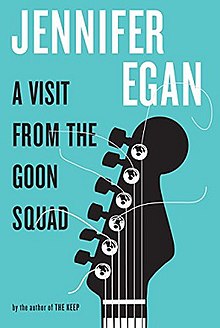
A Visit from the Goon Squad - Jennifer Egan

 A Visit from the Goon Squad - Wikipedia 

Until a few weeks ago I had never even heard of Jennifer Egan (bad me, she's a Pulitzer winner after all!). Then I met a colleague who is writing a PhD thesis on DeLillo, Auster, Whitehead and... Jennifer Egan, so, given the other three names, I figured I might as well read something by her before talking about literature around the office again. 

It's a pleasant read and a nice series of interwoven short stories, full of (not so) veiled criticism aimed at the music industry and our general society and humorous moments. At the same time, though, I can't quite bring myself to consider "pop-rock" literature as something of particular literary significance, probably because I read (and watched) a fair bit of similar things growing up. 

Entertaining, yes. Thought-provoking, relatively. Pulitzer-worthy, maybe not...

Tuesday, 2 January 2018

The Black Album – Hanif Kureishi


Yet another book from the farm. Yet another 50p I’m glad to have invested. Yet another read by Hanif Kureishi that is extremely enjoyable (so much so that it led me and my mom to debate on the author’s status as one of the 20th century great British all-around intellectuals). Yet another novel that ultimately left me only half satisfied though.

The Black Album has many fascinating characters, yet, at the same time, feels immature like the protagonist. With the exception of the main character, all the others in the book appear to me to be too monolithic and simply too representative of leftist intellectualism, Muslim dogmatism or junkie desperation (delete as appropriate).

That being said, to me The Black Album is in so many ways a precursor to White Teeth, and that’s no mean feat, as the delirious interactions between characters and races, the chaotic burning of Rushdie’s The Satanic Verses (which somehow made me think of the launch of FutureMouse), and clearly the peripheral London setting kept on reminding me of Zadie Smith’s masterwork.

Tuesday, 1 August 2017

The Autobiography of Malcolm X – Malcolm X and Alex Haley


A book that was given to me as a Christmas gift by one of my closest friends and, despite my normal lack of enthusiasm for (auto)biographies (or even cinematic bio-pics), was actually a quality present.

Despite teaching 20th century history, I didn’t know much about Malcolm X, so this book was quite eye-opening – I’m not going to debate up to what extent it truly reflects the man’s life (how could I?) but it surely does justice to his myth.

As I read it I kept thinking how much he would have despised me as a rich, white European who teaches on the history of Ghana or Pakistan by starting with the disclaimer “well, I’m a rich, white European” – would have I been the worse of the liberals? And would he have changed his mind after his Hajj

One thing that really struck me was the faith Malcolm X seemed to have in non-white leaders: Elijah Muhammad, Kwame Nkrumah, and even Mao are praised time and again, but, as far as I know, were quite far from being saints themselves (despite the fact that at the time of writing, in Nkrumah’s case, the temptation to identify him as the prototype of the enlightened African leader was quite clearly extremely tempting for everyone).

As I approached the autobiography, I expected its latter parts to be the most exciting ones, but I have to say the chapters I liked the most were probably the early ones, the ones on Detroit Red, the hustler, with his passion for jazz (and his encounters with all the big names of the time) and for swindling people.  

Wednesday, 19 July 2017

White Tears – Hari Kunzru


A random advanced proof copy that my mom managed to find at the Blackheath Amnesty International book sale. Go mum!

Long chunks of this Kunzru novel seemed to be written by, erm, Paul Auster. Seriously, the feeling of alienation was very much the same. Despite the mixed reviews it seems to be receiving, I quite enjoyed White Tears, probably because it deals with white kids who try to adopt black culture with, in their own way, profound respect and self-criticism.

But in all honesty the gory end is just a bit much, and I could have done without the Charlie Shaw takeover – just a bit too (dark) magical for me…

Thursday, 5 January 2017

The Dwarves of Death – Jonathan Coe

The joys of walking into Fopp and finding that it has changed its stock of books quite considerably! This was a Christmas gift to myself (one of the very few I have ever felt entitled to) alongside Brighton Rock and Coe’s The Accidental Woman.

According to Jonathan Coe’s website this is his weakest novel, and according to a number of people on goodreads, the plot twists in the book are just implausible and the focus on music excessive. I disagree with all those accounts. Sure, The Dwarves of Death doesn’t even come remotely close to What a Carve Up! or The Rotters’ Club, but it was a great read on the plane (not to mention the fact that I am currently reading The Accidental Woman and I am finding that to be quite a bit weaker than this book). Also, sure, the plot twists are implausible, but so are the ones of Lock, Stock & Two Smoking Barrels (to which the absurdity of the novel made me think more than once) and this is not a problem for me. Lastly, obviously there is a lot of focus on music, but this is not overpowering and it feels great to read of the inability of the protagonist’s drummer to keep a beat, much like me.

But surely I am biased, as the book is set in the same area of London where I live, although man it has changed over the last 30 years!

Wednesday, 10 February 2016

The Page Turner – David Leavitt


The random books one ends up reading when one (or one’s wife) picks up a large pile of novels primarily because they are free. My parents had been talking for years about While England Sleeps, so I figured I should give Leavitt a try.

It was an enjoyable and remarkably light read. The one issue, though, is that I really didn’t find much in the book that I could relate to: as an Italian expat with very little intention of ever going back to the country I didn’t really find anything too magic in the – rather standard – poetic and idyllic descriptions of Rome; as the stereotypical manly heterosexual man, I found little interest in the heady journey of sexual discovery of the main character; and as a spoiled only child who always got along rather well with his mother, I had very little interest in the relatively problematic relationship between the titular Page Turner and his mom.

So yeah, a good book to read on a Sunday afternoon while one is trying not to think of the state of his legs after running 18 miles (damn marathon training…), but that’s about it for me…

Sunday, 13 September 2015

Novecento – Alessandro Baricco


Either at some point in his career Baricco could really write, or maybe this book was actually written by his neighbour, his brother-in-law, or a random dude he bumped into one day.

Novecento is a delightful theatrical monologue. The implausible story of its main character is an endearing depiction of everyone’s desire for security and the fear of the unknown (ironic for a protagonist who has spent his entire life at sea). The piano duel with Jelly Roll Morton is a work of art, as is the idea of naming the main character Danny Boodman T.D. Lemon Novecento. Unlike the book, Tornatore’s movie – despite remaining very faithful to Baricco’s work – is just a bit too much (not the first time for the director, in my opinion).

It’s just a big shame that something so well-written wasn’t followed by anything of a remotely similar calibre.